By Steve Derderian
sderderian@massgolf.org
KINGSTON/PLYMOUTH, Massachusetts (April 29, 2026) – Chris Gatcomb may forever retire and frame his pitching wedge after the magic that it delivered him on Wednesday.
By around 1 p.m., it felt like the competitive newcomer and his playing partner — 34-year-old former pro hockey player and Brookline firefighter Shane Walsh — had already done enough to win the 45th Massachusetts Four-Ball Championship. The day was already highlighted by an ace by Gatcomb on lucky No. 13 at Indian Pond Country Club, using his pitching wedge (all captured on camera).
After posting 12-under-par 131 through 36 holes and watching that number get matched by mid-afternoon, they ventured to Waverly Oaks for a playoff with the twice-crowned duo of Herbie Aikens and Matt Parziale, yet finished it the same way they had played the entire week: one stepping in when the other needed it.
On the second attempt to decide the outcome on the 18, Walsh’s drive found a divot, and their rangefinder was rendered useless due to the mist and fog that hung over the course. In came Gatcomb, who flighted his trusty PW to inside 6 feet below the hole, and with the stage cleared, he knocked it home for the decisive putt to win it.
“For me personally, it’s such a special day for my golfing career in terms of golf,” said Gatcomb, a 35-year-old Boston transplant from Connecticut who previously served in the U.S. Coast Guard. “I’ve never won a state event, and to have an ace that essentially got us into a playoff is pretty cool.”
View this post on Instagram
Playoff drama aside, the upstart champs opened with a 65 at Waverly Oaks on Tuesday and closing with a 66 at Indian Pond on Wednesday, never once needing both players to carry the same hole. They made 13 birdies across two rounds, almost evenly split.
“I don’t think we birdied the same hole for 36 holes,” said Walsh, who birdied the 18th at Waverly on Tuesday. “We zigged and zagged well. It was great team golf.”
Their path there had already included the kind of moment most players never get. On the 13th hole at Indian Pond, with Walsh settling on the number. “I think wedge is the perfect play for you,” Walsh relayed. Gatcomb trusted it, stepped in, and hit a shot that flew straight at the flag, landed once, and dropped.
“The fact that it’s on video…I’m gonna have that for life, and that’s pretty cool,” he said afterward.
View this post on Instagram
Chris Gatcomb’s path to this moment has never been just about golf. As a Coast Guardsman, he has served on both coasts and overseas in the Arabian Gulf, building a career that combined his passion for mechanics with a commitment to service. In January 2017, that path took a sudden turn when he suffered cardiac arrest, surviving only because of the quick actions of his fellow Coast Guardsmen and an AED that restored his heartbeat. The experience reshaped his outlook, bringing him closer to family and back to the game, while also fueling his work advocating for fellow survivors and veterans.
That perspective showed throughout the week, even as the tournament looked like it was going to be captured by two of the most familiar names in the state.
For the better part of a decade, Aikens and Parziale have made a habit of having a say in how things end, or at least close enough that everyone else starts doing the math, whether they want to or not. Gatcomb and Walsh had done just about everything right over two days, moving through Waverly Oaks without ever putting both players in trouble and answering early adversity at Indian Pond with the same steady back-and-forth that defined their run.
Still, with Aikens and Parziale, no lead seems safe. Starting eight shots back on Wednesday, they made their push behind Parziale’s 64 on his own ball (8-under 63 for the team), burning edges along the way before closing with must-make birdies at Nos. 8 and 9 to force the issue.
The approach in the playoff didn’t change for either side. Aikens and Parziale took driving irons, while Gatcomb and Walsh went driver. Parziale’s approaches ended up far left but puttable, and each nearly dropped from distance, while Aikens, long on his final approach, couldn’t convert the par save.
Even before all the playoff excitement, Gatcomb had already expressed what the week meant to him.
“That was a special round of golf,” he said walking off the 18th at Indian Pond.
“To be able to get an ace in tournament play, and doing it with a good buddy by my side, was really fun,” he added. “I’m not going to forget it.”
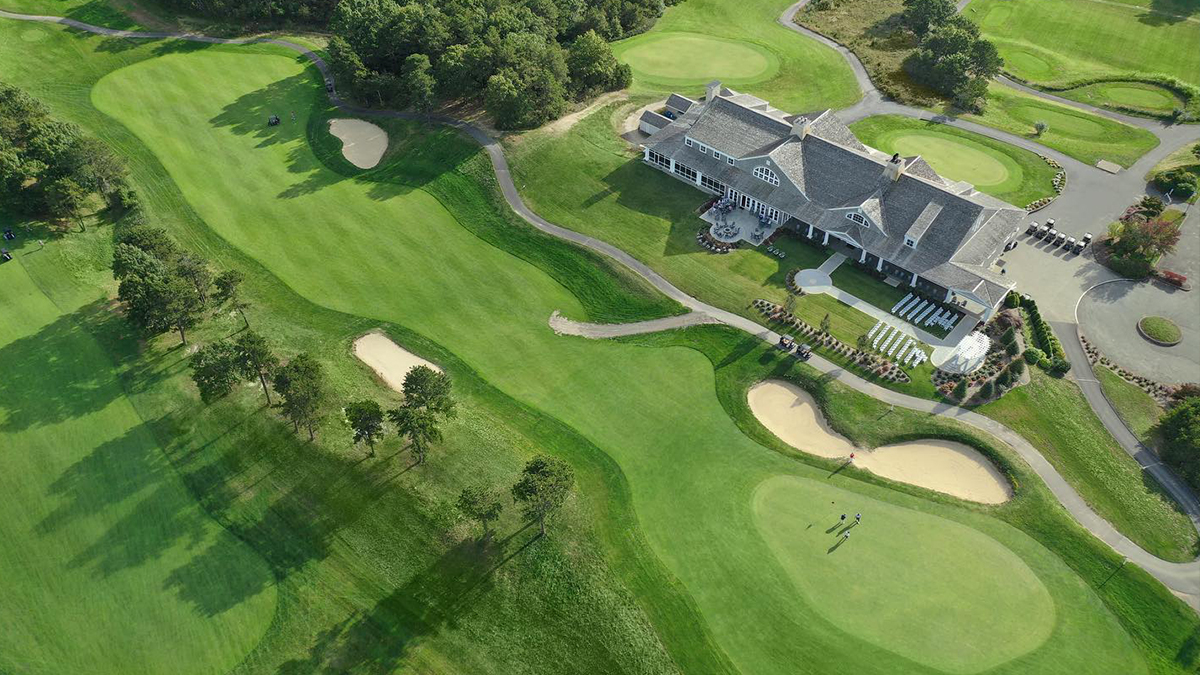
Designed by Brian Silva, the 18-hole championship layout at Waverly Oaks first opened to the public in 1998. Carved through more than 240 acres of rolling New England hills and valleys, the course is framed by lush woodlands and towering oaks, featuring expansive fairways, bold greens, strategic bunkering, and a 150-foot elevation change.
Waverly Oaks offers a wide variety of holes and green complexes, including the par-3 17th, known as “The Black Hole,” which presents one of the most intimidating shots on the course. Any tee shot that falls short of the bunkers—or drifts right—can quickly roll down the steep drop into the hazard below. After a gentle opening on the 1st hole, golfers look forward to the consecutive par-5s on the 4th and 5th. The 369-yard 9th, nicknamed “Double Trouble,” is a classic risk-reward hole: players can lay up short of the water with an iron for a comfortable approach of roughly 150 yards, or challenge the narrow fairway with a driver. The closing stretch features a steep punchbowl green on the 15th, followed by a long downhill par-5 that sets up the demanding 17th.