A Century Of Commemorations At The Center Of Mass Golf’s Celebration Of Black History Month
— February 2026 —
Black History Month began in 1926 as “Negro History Week,” founded by historian Carter G. Woodson, and was expanded to a full month in 1976 by President Gerald Ford. As such, this year’s theme “A Century of Black History Commemorations” invites reflection on the diverse leaders who have shaped our shared past, including the golfers and pioneers who helped shape golf’s history in Massachusetts.
Our state’s golf history is rich with such legacies. We see it in the meticulous mind of Dr. George Franklin Grant, the Harvard dentist who patented the wooden golf tee. We see it in the forethought of Robert Hawkins’ Mapledale Country Club (now Stow Acres), which provided a stage for the first nationwide tournament for Black golfers. There was the brilliant powerful swing of former tennis star Althea Gibson, who once set a course record at Pleasant Valley, as well as the early brilliance of a teenage Tiger Woods, whose 1992 U.S. Junior Amateur victory at Wollaston hinted at the greatness the world would soon come to know. Then there’s community leaders such as George Lyons, Archie Williams, and groups like the Men’s Inner Club and Fairway Ladies who fought to maintain and improve conditions at Franklin Park, home to the second oldest municipal course in the U.S.
These stories continue to rise to the surface, not because of the time of year, but because they speak to something deeper. They remind us that when a community comes together for the greater good, it moves the game to a better place.
This month, Mass Golf is proud to present a series of entries celebrating the legacies of pioneers who not only mastered the sport but also dedicated their lives to ensuring that the walk down the fairway is one everyone can enjoy.
Lefty Brown’s contribution to the Fight for Franklin Park
In recent years, we have traditionally closed Black History Month by recognizing the William J. Devine Golf Course at Franklin Park because of the Boston locals who fought for decades to keep golf alive there, even in its darkest days, when only four playable holes remained.
Lefty Brown, one of the leaders behind the golf course restoration of Franklin Park in the late 20th century. (Boston Globe)
Franklin Park, designed by Frederick Law Olmsted as part of the Emerald Necklace, had hosted golf for more than a century. By 1900, under pro Willie Campbell, it saw tens of thousands of rounds a year. Donald J. Ross later expanded it to 18 holes. Francis Ouimet and Bobby Jones played there.
For Black golfers in Boston, Franklin Park became a crucial foothold in a sport that often excluded them elsewhere. By the mid 20th century, the club had an active membership with over 600 dues-paying members with extremely affordable greens fees.
By the 1970s, however, that foothold was slipping. Budget cuts following Proposition 2½ left the course reduced to four playable holes. Greens were overgrown, cars and trash dotted the landscape, kids on motorbikes used the traps for stunts, and the city had largely stepped back.
Brown had to give up golf due to a heart attack but would still come out to the course with his pals and watch from under tree cover by the first tee. However, he was as passionate as ever about the potential in the course still possessed.
“Even now we got 150 or 200 people [who] come out here, play a few holes,” Brown said in 1979. “They fix this place up, [and there’s] no telling how many people, black and white, will join. You don’t waste gas driving to the suburbs. You got a beautiful course right in your own yard. No, it wasn’t a championship course. It did separate the men from the boys.”
Brown, who has become president of the Bay State Golf Association, which has long advocated for Black golfers in the state, joined forces with Lyons, Williams, McCoy, and the others now listed on that plaque, rallying support through the Franklin Park Golfers Association. They pushed for irrigation, capital investment, and long-term commitment. They organized events like Black & White on Green and built youth programs that opened doors into the game. Their goal, as Williams said, was a multi-racial, multi-gender golf course that reflected Boston itself.
By the late 1980s, the course’s transformation was in full swing. The city enlisted Bill Flynn, the golf course owner and manager who had successfully restored George Wright Golf Course, along with course architect Phil Wogan, whose father had worked with the legendary Donald Ross. Together, they completed the full restoration of Franklin Park, and in 1989, the course officially reopened as an 18-hole public course.
“Golf is a billion-dollar industry, and there’s no reason why we shouldn’t use this course to train the kids in these neighborhoods to be a part of it,” Lyons said in 2003, during the mayoral ceremony.
Perhaps those dreams will be on full display in 2028, when the 125th Massachusetts Women’s Amateur Championship will take place at both Franklin Park and George Wright.
“We look forward to bringing this historic competition to Franklin Park, one of the most iconic and beloved public spaces in Boston,” said Boston Mayor Michelle Wu. “I’m grateful to Mass Golf and our Parks and Recreation Department for bringing exciting, world-class events to our parks.”
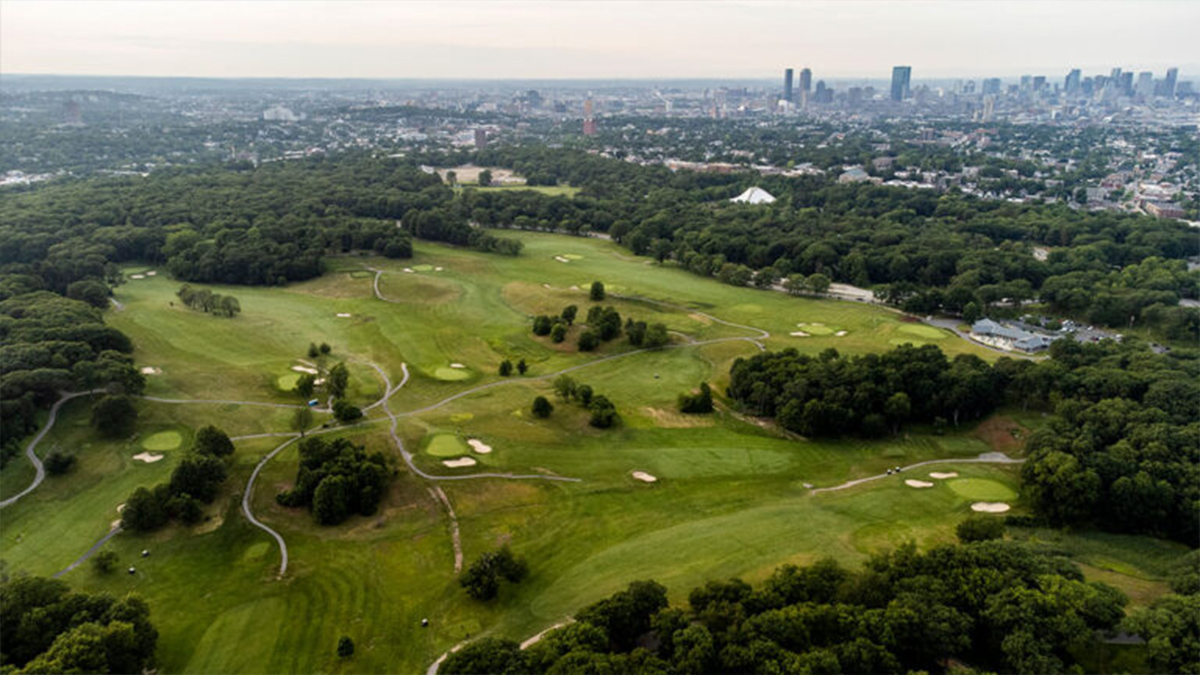
A modern overhead view of William J. Devine Golf Course at Franklin Park. (Teddy Doggett)
August 25, 1996: Jim Dent Wins At Nashawtuc, The Same Day Tiger Woods Rallies For Final U.S. Amateur Victory
— Published February 19, 2026 —
On a humid summer afternoon, Jim Dent walked off the 18th green at Nashawtuc Country Club with the Bank of Boston Senior Classic in hand for the 10th Senior Tour title in his career. At nearly the same time in Oregon, Tiger Woods was completing what would come to be one of his signature comebacks in Sunday red to win his third consecutive U.S. Amateur championship.
Dent was 57, a former Augusta caddie who had built a career on prodigious length and persistence. Woods was 20, already a national draw, adding his final stamp on amateur resume that jumpstarted arguably the greatest career in the game’s history.
Their victories unfolded hours apart, on different coasts and with much different stakes, but shared the same Sunday. Or as Boston Globe reporter Joe Concannon described it simply during his coverage that week: “They spanned two eras of the game in this country — the rising superstar and the old caddie.”
Growing up in Augusta, Georgia, Dent looped for Masters champions Bob Goalby and Bob Rosburg during his time. He went on to build his own career on power and persistence, winning the inaugural World Long Drive Championship in 1974 and eventually 12 times on what is now the PGA Tour Champions. In an era of steel shafts and persimmon woods, he routinely drove the ball more than 300 yards, a feat that made him a legend long before launch monitors existed.
By the time he transitioned to the Senior Tour in the late 80s, he had established a newly-found touch around the greens. He often placed well at Nashawtuc since first playing it when it was the Digital Senior Classic in 1990 saying, “It’s a good golf course. It’s like [John] Daly at Crooked Stick [where he won the PGA Championship]. I can go over the trouble. Some people can’t, so they have to go around it. The [Nashawtuc] golf course suits my game, and I’m close. I’m knocking on the door.”
It would finally take until 1996 to capture a victory at the course, but with a 67 in the final round Sunday to finish at 204 total, he held off Tom Wargo and Jay Sigel by one shot. When neither could birdie the inviting par-5 18th, Dent’s made birdie putt stood. The $120,000 check in his pocket was a long way from the $125 he once made caddying for Patty Berg at Augusta Country Club.
Jim Dent has his hands full with both the Bank of Boston Senior Classie Trophy and his daughter, Victoria, while celebrating with his Son Jamie and wife Mrs. Willye Dent. (Boston Globe)
At Pumpkin Ridge outside Portland, Woods was under real pressure. Facing University of Florida sophomore Steve Scott in the 36-hole U.S. Amateur final before galleries estimated at 15,000, Woods trailed by five holes with 16 to play. He began to chip away in the afternoon, winning three straight holes, but Scott answered. On the 10th, he holed a soft flop shot to hold his ground.
The match tightened at the 16th green. Scott had 10 feet for par; Woods stood over six feet for birdie on the same line. Scott made his putt and noticed Woods had not returned his ball marker to its original spot. Had he stayed silent, the hole and the match would have been over at 3&2. Instead, he spoke up. Woods reset the mark and made the putt.
Two holes later, the match was tied. It went to extra holes, where Woods prevailed on the 38th to secure his third consecutive U.S. Amateur title. Three days later, he stood in Milwaukee and began his professional career with two words: “Hello, World.”
Dent, who passed away last May at age 85, represented a generation that broke through by force of will and talent. Woods represented the unlimited potential that opened once that ground had been claimed.
Before his death, Dent was inducted into the Caddie Hall of Fame, the National Black Golf Hall of Fame and the African American Golfers Hall of Fame. In 2020, the City of Augusta honored him by re-naming the road to its municipal course, The Patch, “Jim Dent Way.”
Laree Sugg, The Third Black Woman On The LPGA Tour, Played Her Rookie Season & More In Massachusetts
— Published February 12, 2026 —
When LaRee Pearl Sugg earned her LPGA card in 1995, she became just the third African American woman ever to compete on the tour, and the first in 17 years. Her LPGA tenure would come in two stints (1995–96 and 2000–01), and while victories proved elusive, her presence carried weight far beyond the leaderboard.
Her debut came in February 1995 when she placed 15th in the Hawaiian Ladies Open. One of her earliest stops as a rookie soon brought her to Massachusetts for the inaugural Friendly’s Classic at Crestview Country Club in Agawam. Because she had conditional status, she had to play her way into the event. Despite not having a practice round, she did so by hitting all 18 greens in regulation to shoot 3-under-par 69 on the 6,381-yard Geoffrey Cornish layout.
Later that summer, prior to the PING/Welch’s Championship at Blue Hill Country Club, she gave a clinic at William J. Devine Golf Course at Franklin Park, three years after 16-year-old Tiger Woods famously did the same.
Beyond the results, she stood as something rarer than a tour newcomer: a visible reminder of a path once opened by Althea Gibson and Renee Powell, but seldom traveled since. Confident, charismatic, and long off the tee, she spoke openly about what her presence meant, not only to herself, but to a game that needed to look more like the world beyond its fairways.
“It was never important to me how I played,” she said. “It was important that people saw me.”
Massachusetts had seen Sugg before. In 1987, as a teenager, she advanced to match play at the U.S. Girls’ Junior Amateur at The Orchards. After winning her opening match, she nearly toppled eventual champion Michelle McGann, winning the first three holes before McGann won holes 6-9 and closed it out on the 16th. Still, she was proving she belonged on the same stage as the game’s brightest young talents.
That belief only deepened at UCLA, where Sugg played for the Bruins for four years after earning the Amy Alcott scholarship. In the 1991 NCAA championship, Sugg was assessed a two-stroke penalty for teeing off in front of the 13th-hole tee markers, but redeemed herself with a playoff birdie to lift her squad to the team title. She also earned Second-Team All-America honors.
Later that year, she earned 3rd place medalist honors in both the U.S. Women’s Amateur Championship and U.S. Women’s Public Links Championship.
Raised in Petersburg, Virginia, she began playing golf at age 6 and went on to win several junior tournaments. However, her inspiration came from countless evenings on municipal fairways with her grandfather, Dr. James C. Nelson.
“It would often just be him and I playing at Dogwood Trace (Golf Course) together, playing the front nine over and over again,” Sugg said in an article about her life on LPGA.com. “We would play until dark…with him telling me life stories about him growing up in Princeton, New Jersey. He was a storyteller. He was teaching me all these things about perseverance and resilience and how to navigate being a Black woman in the world. We were doing all of that through these conversations on the golf course.”
Nelson was a teacher and mentor to young people, so it only seemed fitting that Sugg followed in his footsteps after her playing career ended. When the University of Richmond called in the spring of 2001, she said yes and was hired as their first head women’s golf coach. She was named CAA Coach of the Year in 2002, just one year into her coaching tenure, and went on to serve as the men’s golf coach before moving into more leadership roles in 2005.
Sugg climbed the sports administrative ladder, starting as an Assistant Athletic Director and then growing into her current role at the university, serving as the Deputy Director of Athletics for policy and sports management, the Senior Woman Administrator (SWA) and Chief of Diversity, Equity, and Inclusion (DEI). In 2023, she was inducted into the National Black Golf Hall of Fame as a part of their 37th-anniversary celebration.
While she never achieved her ultimate goal of winning on tour, she was a long proponent of getting younger golfers to follow in her footsteps, advocating for scholarships, good equipment and opportunities to play challenging golf courses.
“I want them to know there are people out there who care about them and get them to be goal-oriented in any sport and to get an education,” she said back in 1995. “People ask me if I feel pressure. I feel some pressure, but usually it’s pressure I put on myself. I was lucky I had people in my life who helped me and were interested in what I could do, and a lot of people don’t have that.
“When you’re the only one out there and only the third one in over 50 years of the existence of the LPGA Tour, I think that carries a lot of weight,” she added. “I think I handled that pressure fairly well throughout my career and tried to use the attention that I would get as an arena to talk about issues as they relate to a minority, specifically African-American players. It was a hard road to toil.”
100 years ago: Robert H. Hawkins Purchases Land To Create Mapledale Country Club, Now Known As Stow Acres
— Published February 5, 2026 —
In February 1926, winter lingered at the Randall Estate in Stow, Massachusetts, a town not far from where the first shots of the American Revolution were fired. From the windows of its twenty-room mansion, the surrounding acreage, 196 in total, lay undisturbed.
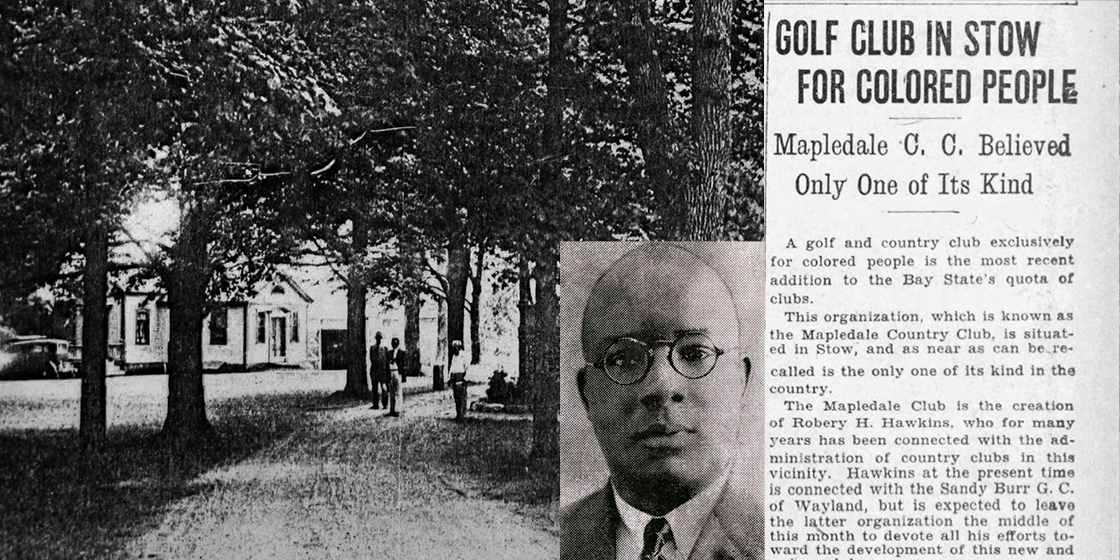
That same month, the property was purchased by Robert H. Hawkins, a successful Black businessman, chef, and passionate golfer. At a time when segregation excluded Black golfers from nearly every course in the country, Hawkins envisioned a resort and golf club where Black men and women could play freely and be welcomed as a community.
He called it Mapledale Country Club. Opened later that year, it would become one of the first Black-owned and operated golf courses in the United States.
Hawkins’ journey to his creation began in Adams, Massachusetts, where he was born and learned the game as a young caddie at Forest Park Country Club, playing in the shadow of the imposing Mount Greylock, the highest peak in the Commonwealth. Before founding Mapledale, Hawkins surely drew inspiration in serving as manager of the new Sandy Burr Country Club in nearby Wayland, earning him the distinction of being the first African-American man to hold that position at a club in New England.
Mapledale opened later that year, and in September 1926 hosted an event that likely outlived Hawkins’ wildest imagination: the “Negro National” championship, a two-day, 72-hole tournament open to any player who could pay the modest $4 entry fee. It was a landmark in American sports history, offering Black golfers a chance to compete in a generation when the PGA of America’s “Caucasian-only” clause (1934-1961) excluded them from nearly all professional play.
It later transformed into the United Golfers’ Association championship, played through to 1976. The organization was reactivated in 2000 to continue the legacy of diversifying the golfing world.
Mapledale was a place of competition and community, of leisure and legacy. It attracted Black professionals, doctors, and entrepreneurs from across the Northeast, offering golf alongside horseback riding, tennis, croquet, and clubhouse amenities, such as a billiards room and lounge. Over the next two years, Mapledale hosted the national tournament again, drawing trailblazers like Harry Jackson, Pat Ball, and John Shippen, who was the first Black golfer to play in the U.S. Open. These events helped establish what would eventually become the United Golfers Association (UGA), a vital institution Hawkins co-founded in 1925 to provide opportunities for Black golfers nationwide.
“He is heavily built; has a round dark brown face; impresses one by his smiles as of an amiable nature,” the New Pittsburgh Courier described Hawkins in a 1927 article about Mapledale. “His club is located 25 miles from Boston in the faith that it would meet a need of his own group. The club is an attractive spacious colonial building of 18 rooms, and the meals are well cooked. The season of 1927 finds his club provided with a golf course of nine holes, tennis, croquet and a bridle path. He looks forward to an expansion that would provide trap and gallery shooting and winter sports.”
However, like many great dreams of the era, Mapledale was short-lived. The Great Depression forced Hawkins to sell the property in 1929. It would later become Stow Acres Country Club, continuing as a public course, though Hawkins’ name and legacy slowly faded from view. When he passed in 1973, his obituary made no mention of the groundbreaking course he once built or the championship he helped launch.
Over the past four years, a dedicated group of Stow residents has worked to ensure that Robert H. Hawkins’ legacy is not forgotten. Their effort, Rediscover Mapledale, is a grassroots initiative committed to honoring Hawkins’ vision and protecting the land where it first took shape. Through educational programming, historic signage, and the creation of a traveling exhibition, the group is reintroducing Mapledale’s remarkable story, not just to Stow, but to communities across Massachusetts.
As part of this year’s centennial celebration, Rediscover Mapledale will host a series of events designed to bring that legacy to life. On Saturday, March 7, acclaimed historian Sean Osborne will lead a storytelling session at Stow Acres Country Club at 3:00 p.m., connecting Hawkins’ work to the broader arc of Black history in New England.
Later this year, on August 29, the club will host the 3rd Annual Robert H. Hawkins Memorial Golf Tournament, followed by the “100 Years of Golf” Gala that evening. The event will also mark the debut of the exhibition Mapledale: 100 Years Thanks to Hawkins, which will travel to schools, museums, libraries, and community spaces throughout the Commonwealth—bringing this long-overlooked story into classrooms and public forums across the state.
While Hawkins’ legacy is being rediscovered, the landscape itself continues to evolve. The South Course, which includes much of the original Mapledale footprint, is now protected by a 151-acre conservation restriction, preserving it for recreational use and shielding it from development.
Ownership of the property has also changed hands. In December, the club was sold to the Walden Group, the company that also owns Black Swan Country Club and recently acquired Blackstone National Golf Club. The North Course, however, has a more fragmented future: the front nine holes were sold to developer Mark O’Hagan, with plans to construct approximately 189 housing units, while the back nine was purchased by the Town of Stow for recreational purposes. A previous agreement allowed the course’s former owner to continue using the land for golf if it was properly maintained, but the terms of that arrangement under new ownership remain unclear.
Still, in a decision that seems to echo Hawkins’ resilience, the club has kept its driving range open to the public all winter, despite more than a foot of snow blanketing the turf. Even as the landscape changes, that spirit of access, community, and perseverance continues to live on.