Back in the U.S. Amateur Four-Ball, with a new appreciation for everything around it
By Jared Winiarz
Mass Golf Member Services
Walking through an area marked “Players and Caddies Only,” I couldn’t help thinking about all the high-level tournaments where I was invited to enjoy from outside the ropes.
Most days working for Mass Golf, I’m helping create championship experiences for our members. That usually means driving to tournaments in the pitch black before sunrise, setting up registration tables, answering Rules questions, coordinating with clubs, and doing everything possible to keep the day running smoothly from the first tee time until the final scorecard is signed.
This time, though, I was the competitor.
That realization hit me during my first U.S. Amateur Four-Ball Championship about a year ago in New Jersey. Everywhere I looked, there were reminders that this was different. Massive signage and towering flags swept across the course. Caddie bibs with our names stitched across the back hung in the locker room. Volunteers handed out yardage books beside stacks of fresh Pro V1s and Pro V1x’s on the range, the kind of small detail that suddenly makes amateur golf feel a lot closer to tour life. And if those goosebumps hadn’t fully set in yet, hearing your name announced on the first tee did the trick.
For a week, the places and routines I usually experienced from the operations side suddenly looked completely different. And honestly, I appreciated all of it more because of that.
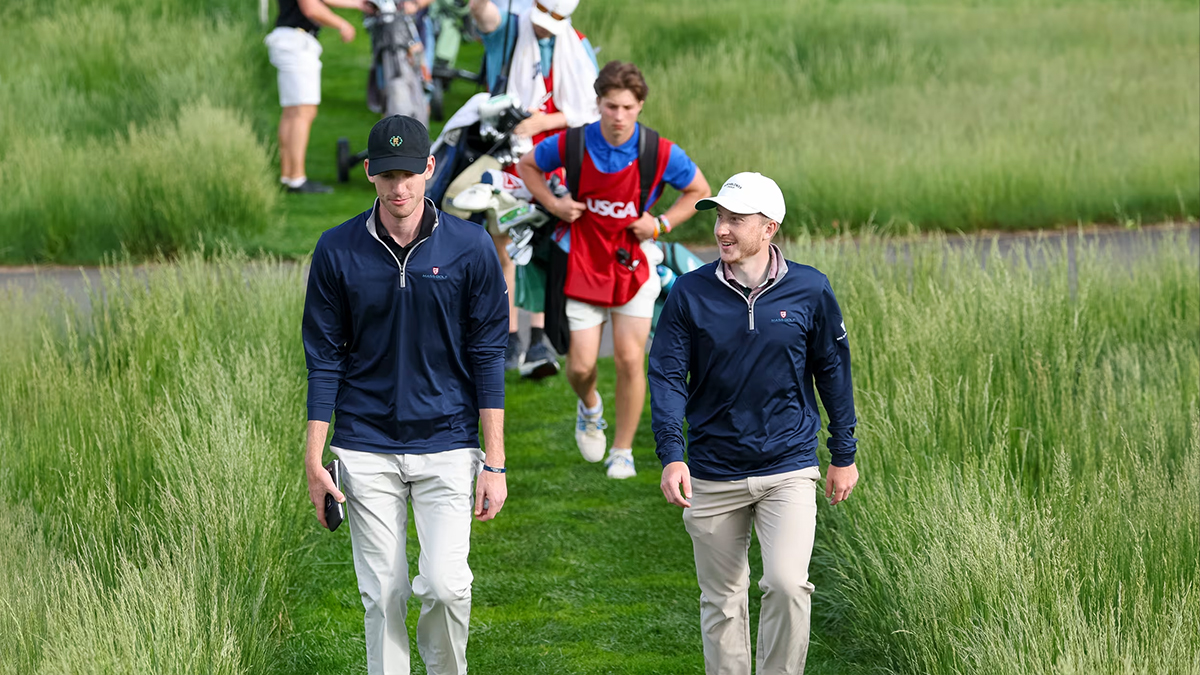
Jared Winiarz, right, and Danny Frodigh made their debut in the U.S. Amateur Four-Ball in 2025. (Simon Bruty/USGA)
Most lifelong amateur golfers will agree that United States Golf Association (USGA) championships sit at the top of the mountain. Getting to play in one isn’t just about earning a special tee time, it’s proof your game can survive one of the toughest tests in amateur golf. For some players, those opportunities come early. For others, it takes years of grinding and agonizing over club choices and near-misses. The real truth is the closest most will get is through spectating or volunteering.
But for those who carry forth anyway while balancing careers and responsibilities, there’s no greater rush than pursuing a spot in a competition that is far from guaranteed.
Now entering my third season on the full-time Mass Golf staff, competitive golf looks a lot different than it did for me at the Uni Hartford and then Babson. I’m fortunate to sync my work with the game I love, but the reality of working in golf is very different than most people imagine. Yes, we spend our days on great courses, but most of the time, they’re temporary offices, not training grounds.
At this point, competitive golf stops being the center of your schedule and starts becoming something more akin to a hobby. Practice turns into quick range sessions after work, late nights in a simulator, or squeezing in a few holes whenever daylight allows. The older you get, the more you realize opportunities like this aren’t guaranteed, which somehow makes the pursuit take on a whole new meaning.
So when my former Hartford teammate Danny Frodigh texted about two years ago asking if I wanted to team up for the U.S. Amateur Four-Ball qualifier, it didn’t take much convincing. “Why not?” I replied.
Individual competition is difficult enough, but four-ball brings a unique kind of pressure. It’s not just ‘can we make birdie,’ it’s ‘how many can we make and will it be enough?’ Bogeys sting twice as much, and momentum can disappear in an instant. The best teams don’t just have the best talent; they understand how to lean on each other when one player’s game starts slipping.
That’s what made our qualifying round at The Bay Club work so well. Danny and I never really let the round get away from us. If one of us made a mistake, the other responded. If one player had momentum, the other didn’t get in the way.
Standing over a short par putt on the 18th green to qualify, I remember thinking how funny it was that the same play-acting pressure scenarios — this putt to win the U.S. Open — we pretended to have as kids can suddenly become very real.
When the putt dropped, the relief hit immediately: We had qualified for the U.S. Amateur Four-Ball Championship. What’s more, I had become the first Mass Golf staff member to earn their place in this one.
Jared Winiarz also made his Mass Mid-Amateur debut in 2025. (David Colt)
But that payoff comes with quite the extensive wait that follows. In New England, we qualify nearly eight months before the Championship Proper, which means the tournament follows you through the fall and into inactive season.
After the holidays, preparation starts feeling more intentional. Winter simulator sessions carry a little more purpose. Cold range balls feel easier to justify knowing exactly what you’re preparing for this year. In college, this is all built into the schedule. Now, you improvise and piece it together yourself.
And after months spent chasing small windows to practice, you finally arrive at the championship thinking the same thing every golfer does: “Ready or not, here we go.”
The golf itself matched everything surrounding the championship. Plainfield and Echo Lake were the kind of classic Donald Ross tests New England golfers grow up admiring, beautiful from a distance and brutally demanding once you stepped onto the first tee. Greens rolled like glass, rough swallowed anything slightly offline, and every hole demanded your full attention.
The field made the whole experience feel even bigger. Some players were fellow USGA first-timers like us, while others looked completely comfortable after years competing at that level. Walking the range or scoring area, you’d see names like former Patriots standout Danny Woodhead and NFL quarterback Sam Bradford, who remind you that even guys who competed for Super Bowl rings still have that hunger for high-level competition.
Ultimately, in Four-Ball, there’s nowhere to hide. Birdies are the currency, and my partner Danny and I simply didn’t cash in enough of them.
Still, walking off the 18th green, neither of us felt satisfied just being there.
“We’ll be back,” we said almost immediately in unison.
A year later, here we upheld that promise.
Last summer, we qualified again, this time at Pinehills, and earned our second straight trip to the U.S. Amateur Four-Ball Championship. The feeling carried a different kind of satisfaction this time. Not because the pressure had faded, but because I understood more clearly what it took to get back, between the practices tucked away inside ordinary weekdays and the commitment required to keep chasing competitive golf as life grows fuller.
As the name suggests, Desert Mountain Club will offer a much different test than what we faced in New Jersey last year. But the goal stays the same: compete well, enjoy the experience, and appreciate another opportunity to tee it up on a stage like this.
I hope more USGA championships still lie ahead, especially a future U.S. Mid-Amateur. But more than anything, I hope I never lose the love for the game that keeps moments like these feeling meaningful.
Because even after all the early mornings, long days, and the juggling that comes with post-collegiate competitive golf, there’s still nothing quite like hearing your name called on the first tee and knowing it took everything you had to earn your way there.
Jared Winiarz is the Member Services Coordinator for Mass Golf. A First Tee of Massachusetts alumnus, former collegiate golfer at the University of Hartford and Babson College, he is still pursuing opportunities in competitive golf.
U.S. Four-Ball Schedule
Saturday, May 16 (18 holes, stroke play)
Sunday, May 17 (18 holes, stroke play)
Monday, May 18 (Round of 32, match play)
Tuesday, May 19 (Round of 16/Quarterfinal matches)
Wednesday, May 20 (Semifinal matches/Championship match)
Mass Players In The Field
*Danny Frodigh (Westwood/Dedham C&PC) & Jared Winiarz (Norton/Segregansett CC)
*Brian Fleckles (Sandwich/Wiano Golf Club) & Peter Hartmann (Sandwich/Blue Hill CC)
*Max Ferrari (Framingham/Framingham CC) & Nick Leibold (Boston/USGA Mass Golf)
*Hunter Stone (Marblehead/Tedesco CC) & James Smith (Jupiter, FL)
(Starting Times – TBA)
About The U.S. Four-Ball
The U.S. Amateur Four-Ball Championship and U.S. Women’s Amateur Four-Ball Championship are among the newest national championships to be conducted by the USGA. The two Four-Ball Championships replaced the now-retired U.S. Amateur Public Links and U.S. Women’s Amateur Public Links Championships, which were conducted for the final time in 2014.
There are 128 sides (teams) in the field. Eligibility states that each member of the side cannot have a Handicap Index® exceeding 2.4. Only 32 sides will qualify for match play following two rounds of stroke play.
Desert Mountain is home to six 18-hole layouts designed by Jack Nicklaus, and a seventh layout that is an 18-hole, par-3 course.
About Mass Golf
Mass Golf is a 501(c)3 non-profit organization that is dedicated to advancing golf in Massachusetts by building an engaged and inclusive community.
With a community made up of over 145,000 golf enthusiasts and over 360 member clubs, Mass Golf is one of the largest state golf associations in the country. Members enjoy the benefits of handicapping, engaging golf content, course rating and scoring services along with the opportunity to compete in an array of events for golfers of all ages and abilities.
At the forefront of junior development, Mass Golf is proud to offer programming to youth in the state through First Tee Massachusetts and subsidized rounds of golf by way of Youth on Course. For more news about Mass Golf, follow on Facebook, X, Instagram and YouTube.