By Steve Derderian
sderderian@massgolf.org
WEST SPRINGFIELD, Massachusetts (August 5, 2026) — Billy Walthouse (Longmeadow Country Club) turned a familiar course into his first U.S. Mid-Amateur berth, Sean O’Donnell (Pinehurst, NC) erased a disastrous opening nine with a 6-under closing side, and Connecticut’s Keven Slyne (Edgewood Golf Course) chipped-in for birdie when nothing less would do.
Three dramatically different routes produced the same destination Wednesday at Springfield Country Club: Wisconsin’s Sand Valley, where Walthouse, O’Donnell and Slyne will compete in this year’s U.S. Mid-Amateur Championship from September 26-October 1.
Walthouse led the way with a medalist round of 3-under-par 69, one stroke ahead of former Arizona Player of the Year Sean O’Donnell and two ahead of Slyne, who supplied one of the day’s most dramatic moments in a late-afternoon playoff.
Online: Results | U.S. Mid-Amateur Championship Home | Mass Golf Home
The decisive stretch for Walthouse came on Springfield’s par 5s, which he played in 4-under. He reached Nos. 12 and 15 in two, then poured in a 40-footer for eagle on the latter to reach 5-under and create the cushion that ultimately carried him to Sand Valley.
The setting added another layer to his first U.S. Mid-Amateur berth. Walthouse’s grandparents have lived since 1992 in a condominium overlooking the uphill, dogleg par-4 17th, where he grew up holding putting contests with his cousins. He played a Sunday practice round with his grandfather, using it to settle on several strategic decisions that paid off Wednesday, then made par beside their home late in his medalist round.
A bogey from the left bunker on the closing par-3 18th trimmed his total to 3-under and left him to monitor the afternoon scores, but no one caught him. The former University of Rhode Island standout and PGA Tour Americas professional earned his first USGA championship berth since returning to the amateur ranks four years ago. In 2017, he made match play in the U.S. Amateur, surviving a 13-for-8 playoff, as well as in the U.S. Amateur Four-Ball with Matt Naumec, who qualified for the U.S. Mid-Amateur at Renaissance on Tuesday.
“Sand Valley has always been on the bucket list,” Walthouse said. “Anytime you get to play in a USGA event, you feel extra special, so it’s nice to know that the game is still there.”
View this post on Instagram
O’Donnell’s round took a far less direct path. Accustomed to firm Bermuda grass in North Carolina, he said he struggled to adjust to the deep rough as well as the softened conditions due to rain, playing the opening nine in 4-over 39. He told his caddie the new goal was simply to return to even par and carry some momentum into the U.S. Amateur at Merion the following week.
Instead, he played the back nine in 6-under. O’Donnell, the Carolinas Mid-Amateur champion, made several quick birdies, rolled in an eagle at the par-5 15th after hitting his approach from a divot and closed with a full 4-iron into the 18th followed by a 20-foot birdie putt on No. 18. His 2-under 70 earned him a second consecutive U.S. Mid-Amateur appearance.
Unsure whether the score would hold, O’Donnell returned to his hotel and watched the leaderboard before realizing he should to call an Uber back to the club. But despite returning, it turned out his spot was secure.
The final berth produced the day’s most dramatic finish, with Slyne emerging from a late-afternoon playoff at 1-under 71 to earn his first USGA championship appearance. Slyne, who found a bunker on the 18th and then knocked down a must-make bogey putt to finish 1-under, missed the opening playoff green to the right, nearly repeating the same mistake he had made there during regulation. Remembering how the earlier chip had released, he adjusted his landing spot and knocked down the birdie putt he needed to remain alive.
On the second extra hole (No. 2, 105 yards), Slyne believed he had struck the perfect tee shot on the downhill short par-3 with his 60-degree wedge, only to watch in disbelief as the ball sailed over the green and settled in the rough. Perhaps there was a little more adrenaline coursing through him than expected. The miss left him a favorable lie, but with the other contenders positioned for birdie putts, merely getting up and down might not be enough.
The flagstick had already been removed, and Slyne saw no reason to put it back. “I knew I had to make it, so I might as well make the hole as big as possible,” he said. “I haven’t had a chip in a couple a couple rounds, so I felt like I was due.”
Moments later, Slyne sent his chip perfectly on line and took one emphatic step toward the hole just as the ball disappeared into the cup. “Well done,” offered one of his playoff counterparts, who then missed his attempt to match Slyne and then could let out, “That’s devastating,” as he moved on to settle the order of alternate spots.
Though new to USGA competition, Slyne was comfortable at Springfield, where he plays several times each year. He has devoted less time to golf since starting a welding business, but found the right opportunity on a familiar course, and did it in his customary style, without a hat, glove or golf shoes.
“It’s something I’ve always done,” Slyne said. “My dad always told me if if you need golf shoes, you’re swinging too hard.”
View this post on Instagram
COMPLETE LIST OF QUALIFIERS AND ALTERNATES FROM SPRINGFIELD COUNTRY CLUB
QUALIFIER (Name, Home, Score)
Billy Walthouse, Longmeadow, MA; (-3) 69
Sean O’Donnell, Pinehurst, NC; (-2) 70
Keven Slyne, Granby, CT; (-1) 71*
ALTERNATES (In Order)
Albie Powers, Spofford, NH; (-1) 71**
Sam Ayotte, Corvallis, OR; (-1) 71
*Advanced with birdie on second playoff hole
**Earned spot with birdie on sixth playoff hole
The club traces its roots to 1896, when a small group of golfers transformed Ethan Brooks’ hillside cow pasture into a makeshift course. For one dollar per month, they fashioned holes from tin cans, whittled saplings into flagsticks and played with gutta-percha balls. “Springfield Golf Club” was formally established on March 15, 1897, and grew to 100 members before the end of its first season. The property soon added land, tennis courts and an expanded clubhouse, while the course grew from nine to 18 holes in 1900.
Much of that early layout endured until 1986, when architects Geoffrey Cornish and Brian Silva introduced five new holes across the property’s rolling, stream-crossed terrain. Twelve existing holes were retained while five entirely new holes replaced what were then Nos. 2, 11, 12, 16 and 17, with two of the holes repurposed for the existing practice area. The project stretched the course to roughly 6,600 yards and carried play onto previously unused land north of the original layout. There, Silva worked streams, steep elevation changes and a deep ravine into the design, framing the new holes with pronounced mounding and deep bunkers while preserving the property’s natural green sites.
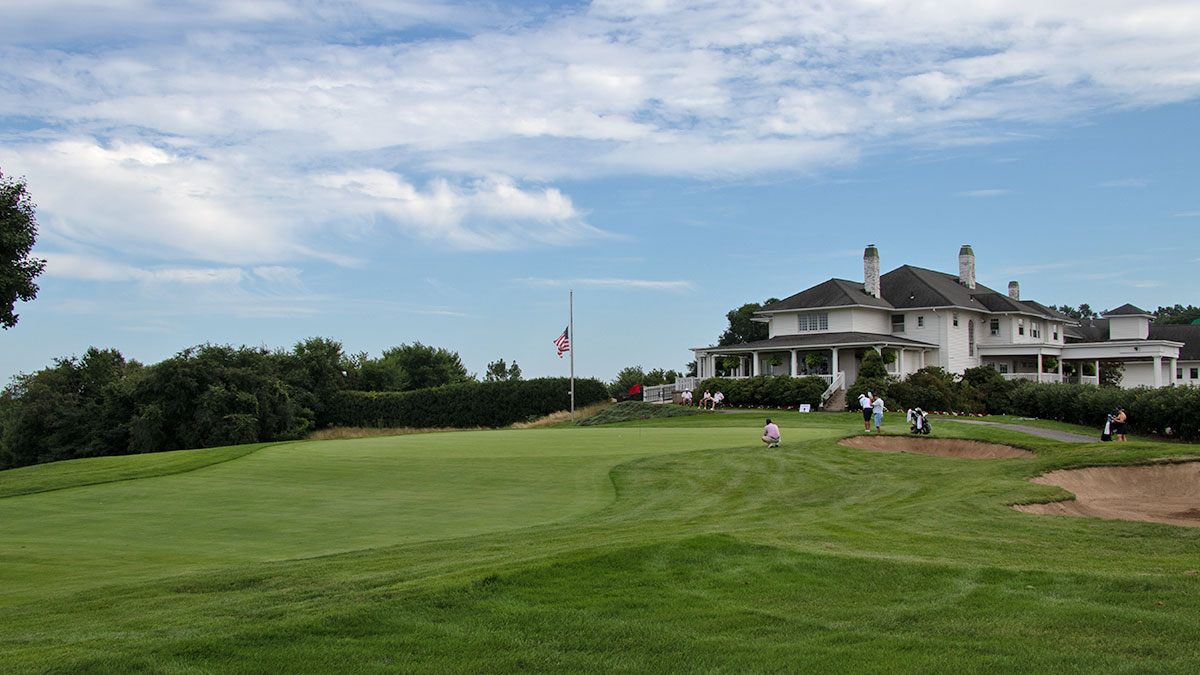
The nines have since been flipped, with round now beginning with a tempting, straight-on 280-yard par 4, its green accessible through a narrow gap between bunkers, followed by a flip-wedge par-3 2nd (tucked well into the back right on Wednesday). The long par-5 8th stretches to a whopping 639-yards, with a split fairway, forcing a carry over a brook and ravine, with an angled green protected by a bunker on the right. The routing finishes each nine with parallel par 3s of roughly 200 yards, with No. 9 climbing sharply uphill toward a large American flag, while the flatter 18th is flanked by extensive bunkering that makes par a perfectly acceptable score, unless of course you’re grinding for a birdie at the end.
For the latest updates on all Mass Golf events, visit MassGolf.org or follow Mass Golf on Facebook, X, and Instagram at @PlayMassGolf.